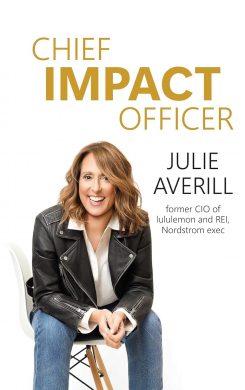
 Excerpt from Julie Averill’s “Chief Impact Officer”
While I was building a culture of psychological safety and authentic connection at lululemon, my personal life was teaching me the same lessons in a completely different context.
The story wasn’t finished. It was just beginning.
During the adoption process of my son, I had presented myself as a single mother to the Ethiopian government. Cindy was described as a friend and caregiver. Being gay was illegal, and since we had never had a formal ceremony, we were able to walk a fine line. It was the only way to ensure Ermias could come home to us.
But as we developed a relationship with the family there, it didn’t feel right. Cindy was his mother and was being introduced as an aide.
I could no longer live this lie. I had done it too many times before in corporate settings to know how it limited real connection. The stakes felt enormous. This was Ermias’s family. In a country where 97 percent of people believe homosexuality should be rejected by society, I was risking the most important relationship in my son’s life.
I consulted an Ethiopian friend living in the United States. He spoke in Amharic and told his Ermias’s family the truth about Cindy and me.
Her reaction? She was completely nonplussed. Matter-of-fact acceptance. Just love. We were family and that mattered more than anything else.
When she shared it with the rest of the family, nothing changed except we grew closer and the wanted to know Cindy more. This was their first time experiencing a gay person. Didn’t matter. Everything felt pure and genuine. Nothing but family and love.
Their acceptance taught me something profound about the difference between institutions and individuals, between cultural norms and personal relationships. While Ethiopians society put law might reject who I was, this family—Ermias’s family—simply saw love. They saw commitment. They saw two people raising their beloved boy together.
From that experience I learned that when you create space for people to show up as fully human, barriers that seem insurmountable become secondary to connection. It had been so focused on what the culture said was impossible that I nearly missed what the individuals were ready to offer.
We first met as a family in Tanzania in 2021. All our kids—Kenzie, Mason, Ermias and Natan—developed sibling bonds immediately. On safari, we watched Ermias and Natan teach each other words. Natan only spoke Amharic. Ermias had stopped speaking it years earlier, but with Natan,fragments came back.“Elephant”in Amharic. “Lion” in English. They’d point, laugh, correct each other’s pronunciation. Two boys finding a language between them that was part Amharic, part English, part sibling.
We asked Wude and Eyayu if we could sponsor Natan in an international school so he’d have access to stronger education. They said yes. Today, Natan is a spicy, loving, funny 10-year-old who speaks near-perfect English. We just put his tenth birthday presents in our suitcase before a family trip to the Philippines, where we all celebrated together.
We have a global family now. We love across borders and time zones. We video-chat every week, text every day. Distance doesn’t diminish connection when there’s genuine commitment. With intention and investment, you can maintain and deepen relationships across any distance.
More importantly, expansion doesn’t require replacement. Ermias doesn’t have to choose between his Ethiopian family and his American family. He gets to have both. That understanding became fundamental to how I approached global teams. People don’t have to choose between their local culture and our company culture. They get to have both. The best teams integrate rather than assimilate.
Every major leadership decision I made after Ethiopia was informed by what I learned there. When I chose internal teams over consultants at lululemon, I was applying the lesson that ownership matters more than polish. When I pushed to hire for a balanced male/female work- force in our India team, I was remembering how much talent gets overlooked when you only hire from familiar patterns. When I banned “onshore/offshore” language, I was thinking about Ermias and the power of words to include or exclude.
The foundation of my leadership transformation wasn’t just technical or strategic. It was deeply personal. It was learning to see strength I hadn’t recognized, to value contributions I hadn’t understood, to build belonging that didn’t require people to lose themselves in the process.
People sometimes ask what adoption taught me about leadership. The answer is everything. The most important transformations happen not when you change people, but when you let people change you. Real strength often looks different than what gets celebrated in boardrooms. The best teams, like the best families, aren’t built on similarity, but on commitment to each other’s growth across difference.
Ermias didn’t just join our family. He expanded what family could mean. And that expansion—of perspective, of possibility, of what it looks like to truly belong to each other—became the foundation for every team I would ever build.
While I was helping scaling lululemon from $2B to $10B, building teams across continents, navigating crisis after crisis, my Ethiopian family was teaching me that the principles I was applying at work weren’t just business strategy. They were how humans actually connect across differences.


